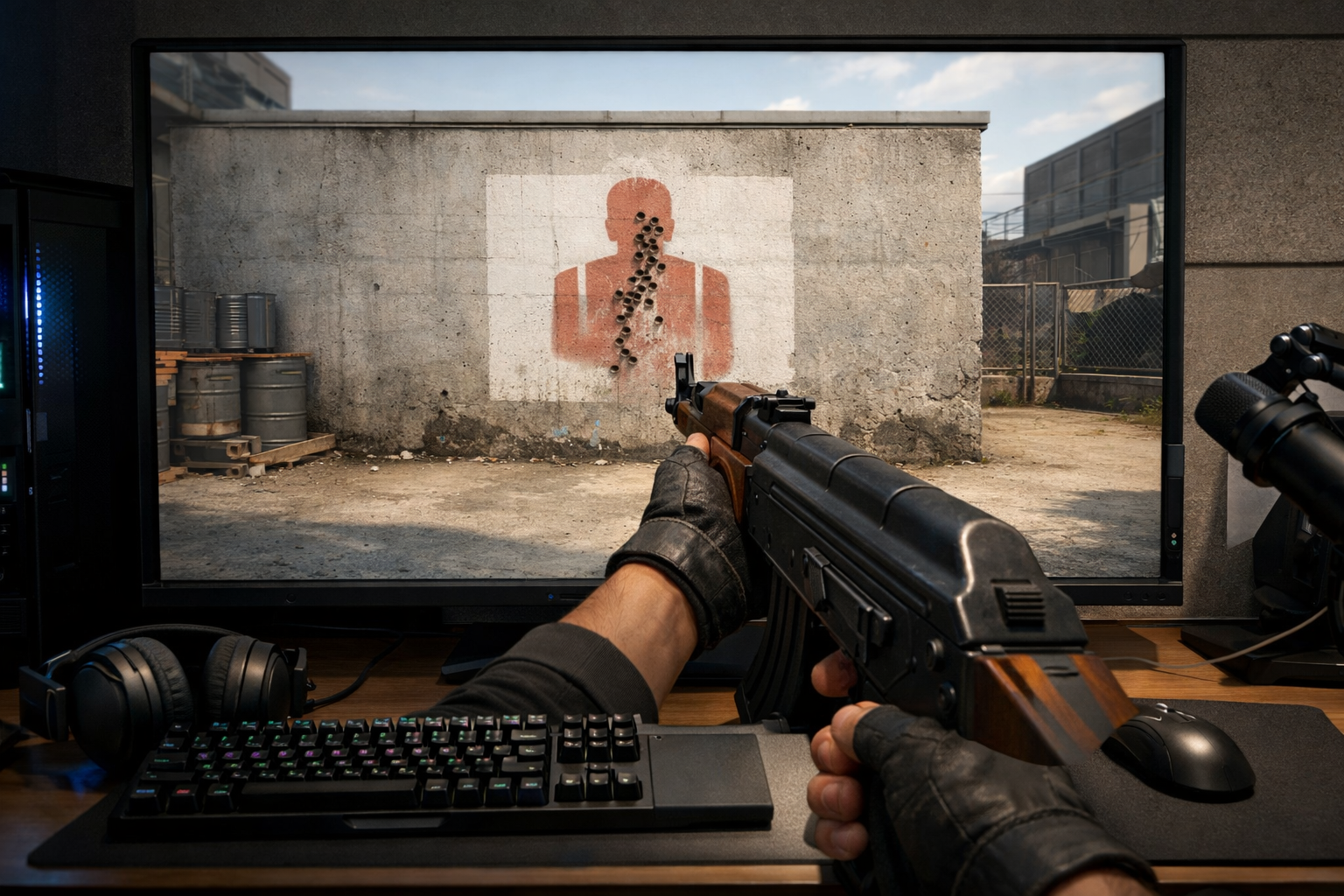
CS2 recoil pattern explained: how spray control actually works
CS2 recoil pattern is the fixed spray path each weapon follows when you hold mouse1. Learning it helps you pull your aim in the opposite direction, keep more bullets on target, and understand when spraying is better than tapping or bursting.
TL;DR
- CS2 recoil pattern is a repeatable spray path that you counter with opposite mouse movement.
- It matters most in close and mid range fights, not every long-range duel.
- Practice the first 10 bullets first, then add transfers and real match situations.
Most rifles in Counter-Strike 2 do not fire straight up forever. After the first few bullets, the weapon climbs and then starts moving sideways in a repeatable shape. That is the core idea behind the CS2 recoil pattern, and it is why uncontrolled sprays miss even when your crosshair starts on the enemy.
In practical terms, recoil control means dragging your mouse against that pattern while staying centered on the target. You are not reacting to random movement every bullet. You are learning a path that often stays consistent enough to build muscle memory.
If you want a broader setup baseline before drilling mechanics, the main CS2 config hub is a useful next stop for settings and player pages. Good settings will not remove recoil, but they can make practice feel more repeatable.
What better recoil control changes in real rounds
The biggest benefit is simple: more bullets land during the part of the fight where players usually commit. In close and mid range duels, that can turn a messy spray into a clean kill before you need to reset.
It also changes your confidence in common situations. Holding a rush, trading through a smoke gap, or stopping a second player after the first kill all become easier when your spray does not drift away after bullet four or five.
A practical example is Mirage A ramp defense with an AK or M4. If two players swing close together, tapping may be too slow once the first target appears. A controlled spray lets you secure the first frag and still keep enough control to transfer onto the second player.
That does not mean spraying is always best. The CS2 recoil pattern matters most when you stay committed to several bullets. If you only fire one to three shots, first-bullet accuracy and reset timing matter more than full spray control.
Why the spray moves the way it does
Each automatic weapon has a built-in recoil path. Early bullets usually rise vertically, then the pattern bends left or right. Because that path is repeatable, you can counter it by pulling down first and then adjusting sideways as the spray develops.
This is different from spread. Recoil is the directional climb you can learn and counter. Spread is the natural inaccuracy around the shot, which means even perfect mouse movement cannot make every bullet land in the exact same pixel.
That distinction matters because many players blame recoil for misses that are really caused by movement, range, or spread. The CS2 recoil pattern is learnable, but it still exists inside a weapon system with accuracy limits.
A simple way to think about it
Imagine drawing a shape on your mousepad in reverse. If the rifle climbs up and then drifts left, your hand needs to move down and then right. The goal is not to memorize a diagram perfectly. The goal is to keep the center of your spray on the enemy long enough to finish the duel.
Many players improve faster when they learn the first 10 bullets first. That part decides most rifle fights. Full 30-bullet mastery can help in niche situations, but the early section gives the biggest return.
When recoil patterns matter most, and when they do not
Spray control matters most at close to medium range with rifles and SMGs. In those fights, enemies are large enough on screen that a controlled spray can stay on target, and the time saved over repeated tapping can be significant.
It matters less at long range, where burst firing is often safer. Even if you know the CS2 recoil pattern, long sprays become harder to hold on a small head hitbox, and spread can punish you before recoil knowledge pays off.
Movement also changes the value of recoil practice. If you are still moving while shooting, your accuracy drops so much that perfect spray compensation may not save the duel. Counter-strafing and stopping cleanly often fix more misses than memorizing the last half of a spray.
Weapon choice matters too. The AK-47, M4A4, M4A1-S, Galil, and FAMAS all reward recoil knowledge, but each feels different. You should not expect one mouse motion to transfer perfectly across every rifle.
Common limits players run into
- They practice full sprays but lose fights because they move while firing.
- They overcommit to spraying at long range instead of bursting.
- They learn one rifle and assume the same pull works on all weapons.
- They drag too hard and overcorrect past the target.
These limits are normal. Recoil control is only one layer of aim. Crosshair placement, stopping, and range selection often decide whether the CS2 recoil pattern can actually help in a live round.
How to practice recoil without wasting time
The fastest approach is short, focused reps. Pick one rifle, stand at a fixed wall distance, and spray while watching where the bullets climb. Then repeat while pulling against that path until the grouping tightens.
After that, move from wall practice to target practice. Start with 5 to 10 bullet sprays on a stationary target, then add target transfers. This teaches you to control the pattern while still making real aim adjustments.
A simple routine can look like this:
- 20 sprays on a wall to read the pattern
- 20 controlled sprays on one target
- 10 spray transfers between two targets
- A few deathmatch rounds using one rifle only
Keep the session short enough to stay sharp. Ten good minutes usually beats thirty sloppy ones. If your sensitivity feels inconsistent during spray practice, checking a stable player setup like jks CS2 settings or frozen CS2 settings can give you a reference point for comparison.
Hardware can also affect how controlled your pull feels, especially on rapid stop-start inputs. If you are curious about keyboard response for movement timing, the Razer Huntsman V3 Pro page is a relevant gear reference.
The best next step is to choose one rifle and one engagement range for a week. Build consistency before adding more weapons. That is usually how the CS2 recoil pattern becomes useful in matches instead of staying as practice-room knowledge.
FAQ
Is recoil pattern the same as spread in CS2?
No. Recoil pattern is the repeatable direction your weapon climbs during a spray, while spread is the built-in shot inaccuracy around that path. You can learn to counter recoil with mouse movement, but spread still limits perfect precision, especially at longer ranges.
Should I spray or burst at long range?
In many cases, bursting is the better choice at long range. Even if you know the recoil path, long sprays are harder to keep on a small target and weapon spread becomes more punishing. Short bursts usually give better control and easier resets.
How long does recoil control take to learn?
Most players can improve basic spray control within a few practice sessions if they focus on one rifle and the first part of the pattern. Reliable match use takes longer, because you also need clean stopping, range awareness, and target transfer timing under pressure.