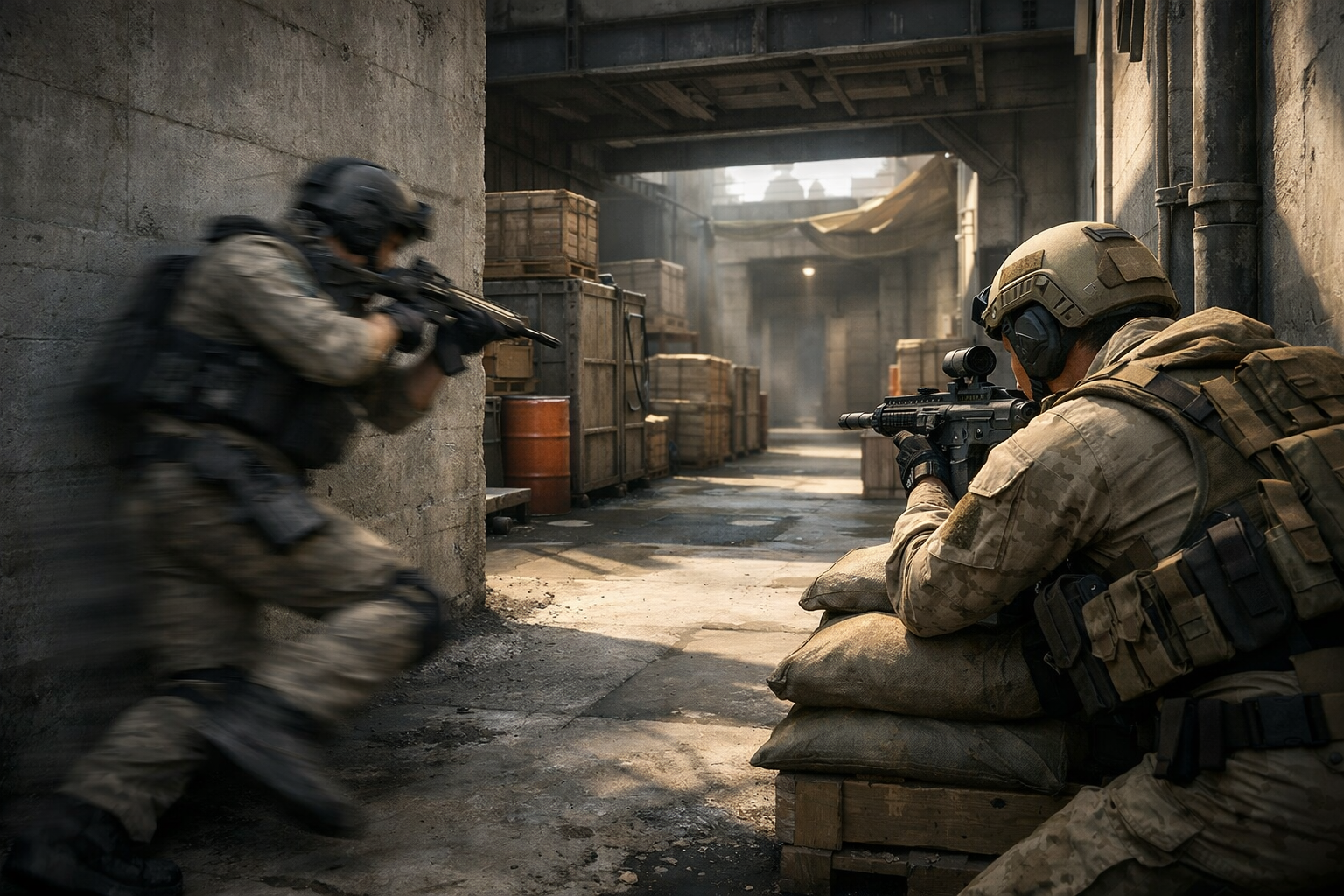
CS2 peeker’s advantage explained
CS2 peekers advantage is the small timing edge the moving player can get when swinging into a fight. In practice, it means the peeker can often see and react a fraction earlier than the player holding still. That does not make every swing free, but it does explain why some duels feel unfair.
TL;DR
- CS2 peeker's advantage is a small timing edge that often helps the swinging player see the duel first.
- It shows up most on tight, common angles with fast swings and predictable defenders.
- You can reduce its impact by using off-angles, repositioning, and avoiding dry static holds.
Most players notice cs2 peekers advantage when they die before the enemy seems fully visible on screen. That feeling is real in many cases, but it is not magic and it is not only about ping. It comes from how movement, server updates, latency, and client-side rendering combine during a fast duel.
If you are still building your basics, the broader CS2 guides section is a useful next stop because peeking works best when your movement and crosshair placement are already clean.
What practical outcome does peeker’s advantage create?
The main result is simple: the player who swings can sometimes register the duel earlier than the player holding the angle. In CS2, that often shows up on tight corners, fast wide swings, and fights where both players are already pre-aimed.
For the peeker, this can make an aggressive move feel crisp and decisive. For the defender, it can feel like there was no time to react. Both views can be true because each client is showing the fight with slightly different timing.
A practical example helps. Imagine a CT holding Mirage connector from top mid while a T swings from underpass. If the T clears the angle with good crosshair placement and movement timing, the CT may only see the model a moment after the T has already started the shot on their own screen.
That does not mean holding angles is bad. It means static holds are weaker when the angle is common, the distance is short, and the peeker expects you. In those spots, cs2 peekers advantage can punish passive positioning.
Why does cs2 peekers advantage happen?
The short answer is that online fights are never perfectly simultaneous for both players. The server has to receive movement and shot data, process it, and send updated information back out. Even with good connections, that process creates tiny delays.
Movement makes those delays matter more. A player who swings changes the visual state of the duel quickly, while the defender is waiting for that new state to arrive. On a held angle, that can make the defender feel late.
Distance and angle shape also matter. A close corner creates a more sudden appearance than a long sightline. That is why a fast swing around a box often feels stronger than a slow shoulder into a long lane.
Crosshair placement adds another layer. If the peeker is already aimed near head level, the timing edge becomes more dangerous. You can see how disciplined aim supports this by checking a player setup page like jks CS2 settings, then comparing how clean settings can support stable pre-aim.
It is also important to separate peeker’s advantage from bad positioning. If you hold too close to a wall, expose too much of your body, or stand in a predictable spot, the duel gets even worse. In many cases, players blame the netcode when the real issue is the angle they chose.
When does it matter most, and when does it not?
CS2 peekers advantage matters most in common online situations: medium ping, tight corners, expected fights, and fast swings. It is especially noticeable when the defender is standing still and relying on raw reaction time.
It matters less when the defender changes the duel before the swing lands. A small reposition, a counter-strafe into a re-peek, or a deeper off-angle can reduce how clean the peeker’s first look will be. Utility also changes everything, because a flash or smoke can remove the clean timing window.
Longer sightlines can reduce the effect, though they do not remove it. On maps with wider lanes, the defender often gets more visual information before the peeker reaches a lethal position. That gives more room for tracking and adjustment.
Weapon choice matters too. An AWPer holding a disciplined line can still punish a swing, especially if the angle is not obvious. If you want to study a player page tied to that style, oSee CS2 settings is a relevant reference point for exploring stable setups around scoped play.
It also matters less in messy fights. If both players are moving, both are clearing multiple threats, or both are partially blind, the duel is no longer a clean example of cs2 peekers advantage. In those cases, decision-making and mechanics usually matter more than the timing edge alone.
Common situations where it shows up
- Holding a close, popular angle without moving
- Defending a choke against a pre-aimed wide swing
- Repeeking the same spot at the same height
- Taking dry duels with no flash support
How should you play around it in real matches?
The best adjustment is not to stop holding angles. The better adjustment is to hold smarter angles and avoid giving the peeker an easy first bullet. Small changes in position can force the attacker to clear more space before seeing you clearly.
Use off-angles when possible. A slight shift left or right can break the enemy’s pre-aim and reduce the value of their swing. You are not removing cs2 peekers advantage, but you are making it harder to convert into a clean headshot.
Another strong habit is mixing static holds with active peeks. Instead of waiting in the same place every round, take one timing peek, fall back, then hold a different line. That changes the rhythm of the duel and can flip the timing pressure back onto the opponent.
Your setup can also help consistency. A stable mouse and pad can make counter-strafing and micro-corrections easier during these fast fights. If you are comparing gear for controlled tracking, pages like the Endgame Gear XM2we or SteelSeries QcK Heavy are practical next reads.
There are limits, though. You cannot fully eliminate online timing differences, and you should not expect one trick to solve every duel. Sometimes the right answer is simply to avoid the dry fight, use utility, or play for a trade instead of a solo hold.
A simple adjustment plan
- Stop holding the most obvious pixel every round
- Stand farther from tight corners when possible
- Use off-angles to punish pre-aimed swings
- Reposition after contact instead of repeating
The best next step if this keeps happening to you
If you keep losing these fights, review your demos with one question in mind: was it really timing, or was I predictable? That single check often reveals whether cs2 peekers advantage was the main cause or just part of a bigger mistake.
Then test one change at a time. Move your hold deeper, add one counter-peek, or ask for a flash before contact. Small adjustments are easier to measure than a full style change.
The practical takeaway is clear. CS2 peekers advantage is real, but it is strongest when you give the peeker a clean, expected duel. If you vary your angles, use utility, and avoid static habits, the effect becomes much easier to manage.
FAQ
Is peeker's advantage stronger in online CS2?
Yes, in many cases it is more noticeable online because latency and server updates affect what each player sees. The effect is usually small, but on tight angles and fast swings it can decide a duel before the defender feels ready.
Should I stop holding angles because of it?
No. Holding angles still works, especially with deeper positions, off-angles, utility, or an AWP. The better approach is to avoid obvious static holds and mix in movement, repositioning, and support so the peeker gets a less comfortable fight.
Does lower ping remove cs2 peekers advantage completely?
No, lower ping can reduce how noticeable it feels, but it does not erase the timing differences of online play. Movement, angle geometry, pre-aim, and your position still shape whether the peeker gets a useful edge in the duel.