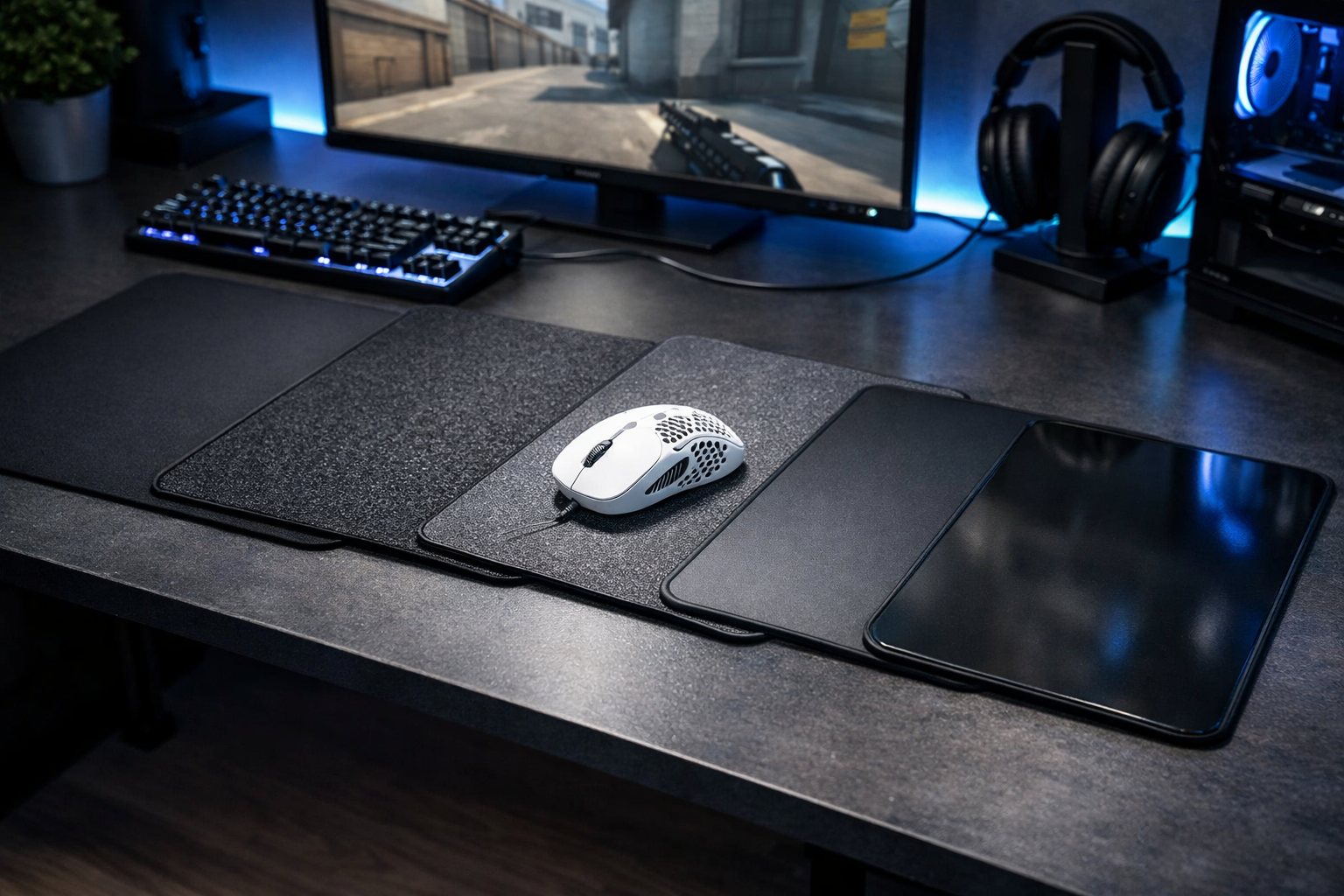
Best mousepad for cs2 in 2026: speed vs control tradeoffs
The best mousepad for CS2 in 2026 depends on your aim style more than hype. The best mousepad for CS2 is the one that balances glide, stopping power, and consistency for your sensitivity, mouse skates, and desk space.
TL;DR
- The best mousepad for CS2 is usually a balance between glide and stopping power.
- Speed pads help fast swipes, while control pads help micro-adjustments and spray stability.
- Most players should start with a balanced cloth pad, then adjust based on overshooting or undershooting.
Choosing the right pad in CS2 is a tradeoff, not a simple upgrade path. Faster surfaces can help with quick flicks and broad swipes, while control pads can make micro-adjustments and spray corrections feel steadier.
If you want a reference point before comparing surfaces, this mousepad guide gives a broader gear overview. For most players, the best mousepad for CS2 comes down to how much friction you want during tracking, tapping, and recoil control.
Why the best mousepad for CS2 is really a speed vs control choice
The main tradeoff is simple: more glide usually means less stopping power, and more stopping power usually means more effort per swipe. In CS2, that affects how stable your crosshair feels when clearing angles, transferring sprays, or correcting after a missed first bullet.
Speed pads often feel smoother and lighter under the mouse. They can suit players who use lower friction skates, wider arm movements, or a style built around fast entries and aggressive peeks.
Control pads add resistance that can make your hand feel more anchored. In many cases, that extra friction helps when you need to hold a tight line, make tiny head-level corrections, or stop exactly on target.
This is why the best mousepad for CS2 is not automatically the fastest or the slowest option. It is the surface that matches your sensitivity, your pressure on the mouse, and the way you aim under pressure.
What improves, and what gets worse, with each surface type
A compact tradeoff matrix makes the comparison clearer:
| Surface type | Usually improves | Usually gets worse | Best fit |
|---|---|---|---|
| Speed pad | Fast flicks, low effort swipes, quick repositioning | Stopping precision, stability under tension | Low-friction preference, aggressive aimers |
| Balanced pad | Versatility, consistent tracking, mixed aim styles | Less specialized feel | Most players |
| Control pad | Micro-adjustments, spray control, angle holding | Swipe speed, fatigue on large movements | Players who value precision first |
Speed surfaces can feel excellent in deathmatch because they reduce drag during repeated turns. The downside appears when nerves kick in and your hand adds too much force, because the mouse can overshoot more easily.
Balanced pads are often the safest recommendation for mixed CS2 play. They do not dominate one category, but they can keep your aim predictable across rifling, AWPing, and routine utility movement.
Control pads can reward disciplined crosshair placement. If your aim relies on small corrections rather than huge flicks, the extra friction can make your movement look less flashy but more repeatable.
Surface texture also changes the result. A rougher cloth pad may feel controlled without being extremely slow, while a smoother cloth pad may sit closer to balanced. If you are also tuning visual precision, checking common CS2 crosshairs can help you judge whether misses come from aim feel or crosshair clarity.
- Choose speed if you often feel stuck or heavy during wide swings.
- Choose balanced if your aim needs one pad for every weapon role.
- Choose control if you often overshoot tiny corrections.
- Choose larger sizes if you play low sensitivity and use your arm.
Common mistakes when comparing the best mousepad for CS2
One common mistake is treating mousepads like isolated gear. The best mousepad for CS2 changes depending on your mouse weight, skates, sensitivity, and even how hard you press into the pad during tense rounds.
A very light mouse on a very fast pad can feel too loose for some players. By contrast, a heavier mouse on a control pad can feel planted and stable, or simply sluggish if your sensitivity is already low.
Another mistake is assuming pro preference gives a universal answer. Many players look at setups for inspiration, but you should use them as context rather than proof. If you want to compare how a competitive setup is built, see rain’s CS2 settings and note how gear choices work together.
Players also confuse break-in feel with long-term consistency. Some pads feel great on day one, then slow down noticeably with humidity, dust, or wear. Consistency matters because CS2 rewards repeatable muscle memory more than short bursts of comfort.
Finally, many buyers focus only on brand reputation. A respected pad can still be wrong for your desk, your arm sleeve use, or your preferred friction level. The best mousepad for CS2 is the one you can trust in the same way every session.
Which mousepad path makes sense for your playstyle?
If you are unsure, start in the middle. A balanced cloth pad is often the easiest path because it gives enough glide for movement-heavy rounds while keeping enough control for taps and spray corrections.
If your misses usually go past the target, lean toward control. If your misses die short or your hand feels like it is dragging through mud, lean toward speed.
For low-sens riflers and angle holders
Low-sensitivity players often benefit from medium or control-oriented cloth pads, especially in larger sizes. These pads can support long arm swipes while still giving enough stopping power to end the movement cleanly.
If that sounds like your style, a control-leaning option such as the VAXEE PA Hoarder is worth a closer look. It fits players who want a planted feel without jumping straight to an extreme surface.
For fast entry players and lighter-mouse users
If you use a very light mouse and prefer quick, reactive movement, a faster or more balanced pad can make the setup feel more alive. That matters most when your game relies on fast clears, quick turns, and low-effort repositioning.
Mouse weight changes the equation, too. If you use something very light like the Finalmouse Ultralight X, pairing it with too little friction can become unstable, so many players still prefer a balanced cloth surface instead of a pure speed pad.
Summary: the best mousepad for CS2 depends on your misses
The clearest way to choose is to study your bad shots. If you overshoot, add control. If you undershoot or feel resistance on every large swipe, add speed.
For most players, the best mousepad for CS2 is a balanced cloth pad with enough size for their sensitivity and enough consistency for daily play. That recommendation changes in edge cases, especially with very light mice, very low sensitivity, or players who strongly prefer either locked-in precision or effortless glide.
If you are still deciding, compare your current setup against a balanced baseline first, then move one step faster or slower. That approach is usually more reliable than chasing the most popular surface category.
FAQ
Should most players choose speed or control pads?
Most players do best with a balanced cloth pad first. It gives enough glide for movement and enough stopping power for precise corrections. From there, move toward speed if your swipes feel heavy, or toward control if you often overshoot targets.
Does mouse weight change the best pad choice?
Yes, mouse weight can change how a pad feels in real play. Very light mice can feel too loose on very fast surfaces, while heavier mice may feel steadier on control pads. The best result usually comes from matching pad friction to your mouse and sensitivity together.
How do I know my pad is too fast?
Your pad may be too fast if small corrections keep sliding past the target, especially in tense rounds. You might also notice unstable spray transfers or trouble stopping cleanly on head level. In that case, a more controlled cloth surface can often help.